Armenian wedding is a very big holiday. The ceremony includes betrothal, engagement and wedding itself. All the relatives and family friends are invited, presents are bought, and food is cooked. All so that everyone can celebrate the health and success of the new couple. As a rule the closest married couple known by the groom and the bride is the God family. The Godfather must bring the most expensive wedding gift. By the way, giving presents is a separate ceremony. The relatives of the groom and the bride and the guests give the newly-married couple jewelry, fabrics, household goods, and money. Armenian weddings are more of a celebration for the parents, and cost a lot of money, that is why parents are the ones who mostly pay for it. But nowdays there are couples who prefer a smaller party with their closest people, friends and minimal traditions. Personally I think that armenian weddings are really beautiful, but everyone has the right to not follow the traditions and choose how to celebrate their special day without being judged.
Homework

1 According to paragraph 1, what has happened in some oil producing countries?
A They are unwilling to sell their oil any more.
B They are not producing as much oil as they used to.
C The supply of oil is unpredictable.
D Global warming is more sever here than in other countries.
3 Which of the following is NOT a benefit of Smart Grid technology to consumers?
A It can reduce their electricity bills.
B It can tell them how much energy each appliance is using.
C It can allow them to turn appliances on and off when they are not at home.
D It can reduce the amount of energy needed to power appliances.
4 According to paragraph 4, what is the problem with using renewable sources of power?
A They do not provide much energy.
B They often cause system failure and blackouts.
C They do not supply a continuous flow of energy.
D They can’t be used at off-peak times.
5 In paragraph 6, what can be inferred about cities in the future?
A More people will be living in cities in the future than nowadays.
B People in cities will be using cars and buses powered by electricity.
C All buildings will generate their own electricity.
D Smart Grid technology will only be available in cities.
6 The word ‘remote’ in paragraph 5 could be best replace by:
A isolated
B crowded
C attractive
D alone
7 The word ‘underway’ in paragraph 6 is closest in meaning to:
A permanent
B complete
C beneficial
D in progress
8 17 What is the main idea of the final paragraph? (paragraph 6).
A To describe who will benefit from Smart Grid technology first.
B To outline the advantages of Smart Grid technology.
C To summarise the main ideas in the previous paragraphs.
D To describe how, where and when Smart Technology will be introduced.
9 In paragraph 6, what can be inferred about the introduction of Smart Grid Technology?
A The technologies which produce most benefits will be introduced first.
B The cheapest technologies will be introduced first.
C The technologies which are most difficult to put into place will be introduced first.
D Technologically advanced systems will be introduced first.
Classwork
Dictionary word-Time periods
Exercise 2
- The era of space exploration started in the 1969s.
- The computer span has helped to improve global communication.
- The discovery of the Americas began an epoch of adventure.
- From 1990 to the year 2000 is the last decade of the 20th.
- Many colleges in the United States run on a semester system.
- The president of the United States can only serve two terms of four years.
- The Civil war was the climax of very important period in the growth of the United States of America.
- The northern part of the country experience a very cold era in the winter of 1993.
- The pony express lasted for a span of 18 months.
Exercise 3
- oppose, resist, start, rebel.
- protest, demonstrate, riot, improve.
- plead, urge, teach, request.
Exercise 1: Working out the meaning
- arid:dry/wet
- gathering:collecting/scattering
- plentiful:scarce/abundant
- particular:special/general
- nomadic:wandering/farming
- Accompanied:settle with / went with
- Expedition:journey/trade
- laborers:traders/workers
Exercise 4:
- expedition, journey, voyage, reservation
- ranchers, farmers, laborers, neighbors.
- gathering, collecting, hunting, picking.
- wanderer, tribe, traveler, nomad.
My favorite Armenian
When you think of an Armenian first of all you remember about Charles Aznavour. But I tried to write about not less important Armenian Henri Verneuil.
Henri Verneuil was a French-Armenian playwright and filmmaker, who made a successful career in France. One of his biggest jobs, that I love is the film “Mayrig”(mother). It is about his life. Everybody has to watch this film at least once, because it has an important message to give and Henri Verneuil was so honest in every detail.
Verneuil (Ashot Malakian) was born to Armenian parents in Rodosto, East Thrace, Turkey. In 1924, when Ashot was a little child his family fled to Marseille in France, to escape persecution after the Armenian Genocide. He later recounted his childhood experience in the novel Mayrig, which he dedicated to his mother and made into a 1991 film with the same name, which was followed by a sequel, 588 Rue Paradis, the following year.
Verneuil entered the École Nationale d’Arts et Metiers in Aix-en-Provence in 1942. After graduation, he worked as a journalist, then became editor of Horizon Armenian magazine.
In 1947, Verneuil managed to convince the established European film actor Fernandel to appear in his first film.
In 1951 he directed his first feature, the black comedy La Table aux crevés. His second film, Forbidden Fruit (1952), based on a Georges Simenon novel, was even more acclaimed.
Later he also directed other movie stars including Jean Gabin, Alain Delon, Lino Ventura (all together acting for him in “Le clan des siciliens” in 1969), Jean-Paul Belmondo (“Le Corps de mon ennemi” in 1976 and other films), Omar Sharif, Claudia Cardinale (Mayrig), Yves Montand and Michèle Morgan. Verneuil has filmed almost all the great figures of French cinema, with the exception of Bourvil, as even Louis de Funès has a small role in one of his films.
After the American experience (he was called the “most American of French directors”), in 1969 Verneuil “found” France. He was awarded a César in 1996 and he was elected a member of the Academy of Fine Arts in 2000. He died at Bagnolet, a suburb of Paris, in 2002.
The opening of the seventh annual Golden Apricot International Film Festival in Yerevan paid tribute to Verneuil. His son, television director Patrick Malakian, who reclaimed the name of his historical ancestors, received the posthumous award, the Parajanov’s Thaler, for his father’s contribution to cinema.
For exactly 40 years, the prolific Verneuil made movies as mainstream and commercial as any to be found in America or Britain. In his best period – the 1950s and 1960s – he delivered films in the “tradition of quality” so despised by the Nouvelle Vague. Many of them proved excellent vehicles for old-timers Jean Gabin and Fernandel, and newcomers such as Jean-Paul Belmondo and Alain Delon.
He was nominated for Oscar and Palme d’Or awards, and won Locarno International Film Festival, Edgar Allan Poe Awards, French Legion of Honor, Golden Globe Award, French National Academy of Cinema and Honorary Cesar awards.
Project “An email to a friend”
Hi Elen, everything’s good, thanks:)
I’m so happy to hear that you had a good time. Yes, you’re right. I was planning a trip with my mom. We used to go in March, but everything got canceled because of the coronavirus. We got sad at first, because we have planned so many things and bought everything needed (new comfortable clothes for long walks, a new camera and some armenian souvenirs for our friends and relatives that live in Europe). But we try to stay positive because everything happens for a reason. I hope that one day we’ll travel together.
Love and miss you, Lilit.
Ice hotel in Sweden (Jukkasjarvi)

Can you imagine a hotel that is entirely made of ice? Well, it exists in Sweden, but only in winter. In spring the hotel melts away and disappears into the river.
The Ice hotel is situated on the shores of the Torne River in the old village of Jukkasjarvi, Sweden. Every winter, work starts on building a new Ice Hotel, involving 40,000 tons of ice and snow. 10,000 tons of ice is taken from the Torne River, and 30,000 tons of snow is provided by Mother Nature.
The first Ice Hotel was built in 1990. It started as a single room — now it has 64 rooms, as well as an ice chapel, an art gallery, a cinema, a theatre and Absolut Ice Bar, Last winter, more than 14,000 guests spent the night at the Ice Hotel.
Outside, the temperature is -30°C, but inside the hotel, the temperature is always around -5°C.
All the furniture is made of ice, including the beds, but nobody gets cold. The beds are covered with reindeer skins and guests are given warm clothes and special arctic sleeping bags.
In the Absolut Ice Bar, the drinks are served in glasses made of ice, so there is no need for ice cubes!
Every year the interior of the hotel is designed by different artists from all over the world. It is described by visitors as ‘absolutely stunning’, ‘one of the most beautiful places I’ve ever seen’ and ‘unique’.
Also there is an ice church near the hotel for the couples, that are getting married.

THE HISTORY OF ICE HOTEL
In 1989, Japanese ice artists visited Jukkasjarvi and created an exhibition of ice art.
In 1990, French artist Jannot Derid has created an exhibition in an igloo (it is an accommodation made with snow and ice). 
One night there were no available rooms in the town, so the visitors and tourists asked for permission to spend a night in the igloo.
The interesting idea of opening the first “Ice Hotel” in the world came from that night.
THE CHURCH

Each year the ice church is consecrated at the Christmas Day service. Every winter in the church around 140 couples get married, and around 20 children are baptized. Most of the baptized children live in the parish. The wedding baptism goes on with the same ritual as in the other cities in Sweden. Reverend Jan-Erik Kuoksu from the Jukkasjarvi parish is the only clergyman, who performs the church ordinances.
He is the priest of the ice church for the first 14 years. His wife, Lisbeth is the church usher.
Here are some pictures of the “Ice hotel”
/romania--southern-carpathians--fagaras-mountains--room-in-ice-hotel-634462653-598a5f03d963ac001104a5d5.jpg)


Distance learning
Task 1
Choose the correctly formulated Passive constructions.
- This easy work can be done without anybody‟s help.
- We found the room exactly as it had been left the night before.
- Tobacco introduced to France by Jean Nicot.
- This modular computer has used by our researchers.
- Gayane was first staged on December 3, 1942 in Perm during World War II.
2.
- The first chewing-gum was made by Thomas Adams.
- Have these benches painted recently?
- The students being examined by the professor at that time.
- The vase made of crystal was broken to pieces.
- Lincoln was shot in the head by John Wilkes Booth, an actor.
3.
- Marie Tussaud created her first wax figure (of Voltaire) in 1777.
- Before him lay a splendid garden, full of blossom and scent.
- I have been misunderstood – no intention to hurt you.
- Is that big hat made of straw?
- Many of Van Gogh‟s best works were created in 1889, in an asylum.
4.
- He will have published several poems by the end of the year.
- What holidays are celebrated in your country in autumn and winter?
- G. Washington is known to all Americans as “The Father of the Nation”.
- The dynamite had invented by Alfred Nobel.
- Charlie Chaplin is considered one of the most famous stars of the early days of Hollywood.
5.
- Will the scientific seminar be held in two days?
- The scientists have been making these experiments for the last few years.
- Nobel preferred that people didn’t remember him as the inventor of dynamite.
- The patent matter was still being discussed.
- The Smiths weren’t invited to that meeting.

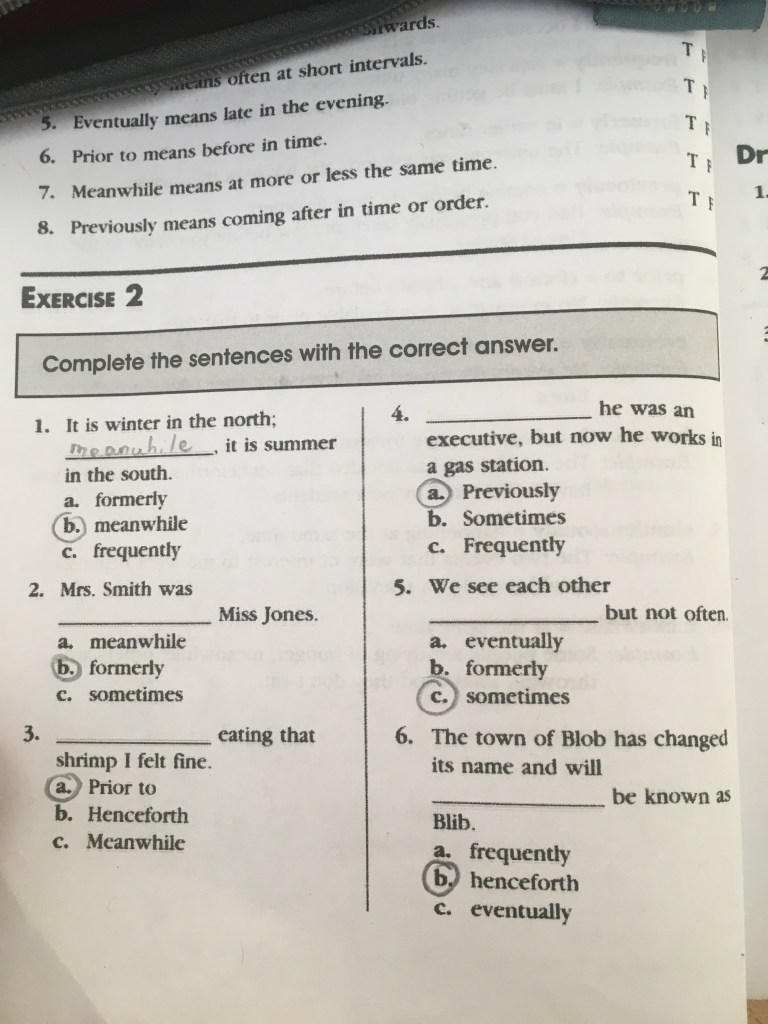
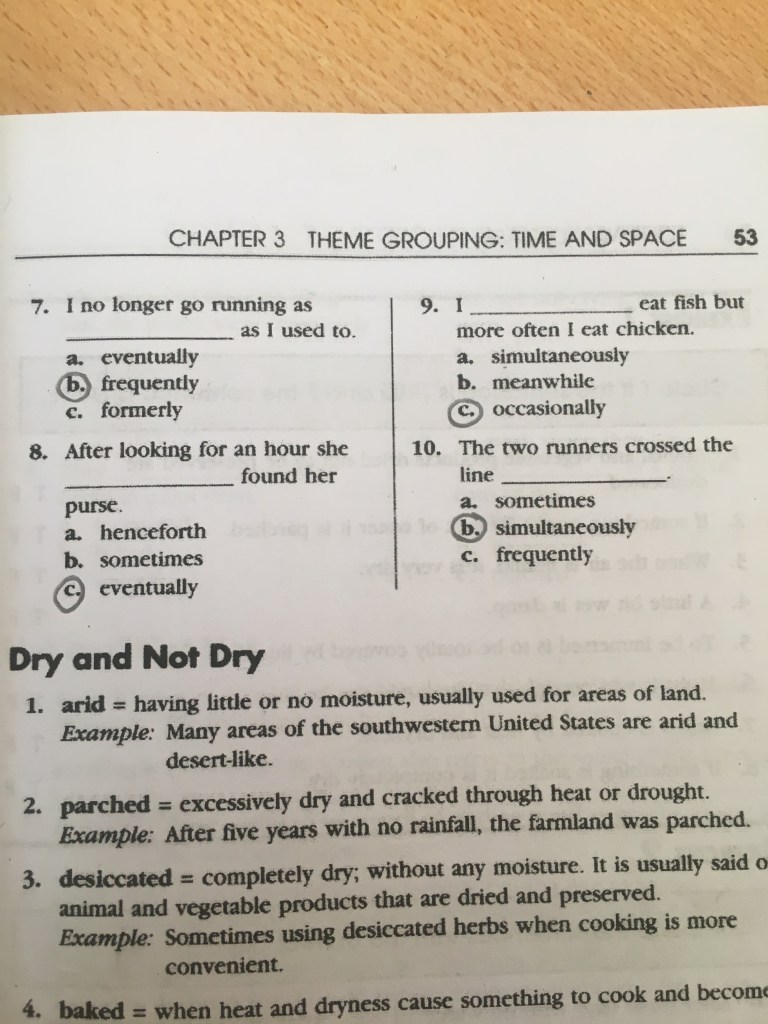
Homework
task 1
Two years ago Trisha’s firm made the mistake of sending her to Germany. Although she had studied German at school, she soon discovered that she couldn’t remember very much. She missed an important meeting because she had forgotten that “halb neun” in German means half past eight in English. So while she was having breakfast her colleagues were already at the meeting. When she arrived “on time” , the meeting had already finished. When she got back to England, Trisha joined a German course at her local college. While she was driving to work every day she was listening to language CDs. In the past few weeks her German has improved a lot and now she knows how to tell the time ! Right now she is studying hard for an examination. Next year Trisha is planning to spend her summer holiday in a language school near Munich. After that, she hopes that her company will send her to Germany again.
task 2
Reading Comprehension – Elephants
Elephants are large mammals of the family Elephantidae and the order Proboscidea. Traditionally, two species are recognized, the African elephant and the Asian elephant, although some evidence suggests that African bush elephants and African forest elephants are separate species. Other families of the order Proboscidea, including mammoths and mastodons are now extinct.
Elephants are scattered throughout sub-Saharan Africa, South Asia, and Southeast Asia. Male African elephants are the largest surviving terrestrial animals and can reach a height of 4 m (13 ft) and weigh 7,000 kg (15,000 lb).
All elephants have several distinctive features the most notable of which is a long trunk or proboscis, used for many purposes, particularly breathing, lifting water and grasping objects. Their incisors grow into tusks, which can serve as weapons and as tools for moving objects and digging. Elephants’ large ear flaps help to control their body temperature. Their pillar-like legs can carry their great weight. African elephants have larger ears and concave backs while Asian elephants have smaller ears and convex or level backs.
One of the biggest threats to elephant populations is the ivory trade, as the animals are poached for their ivory tusks. Other threats to wild elephants include habitat destruction and conflicts with local people. Elephants are used as working animals in Asia. In the past they were used in war; today, they are often put on display in zoos and circuses.
COMPREHENSION:
- Mammoths and mastodons live in Africa.
a. True
b. False - Elephants live in all continents.
a. True.
b. False. - Ivory trade is the main threat that elephants are facing.
a. True
b. False
The project “the poems”
Հին աշխարհքը ամեն օր
Հազար մարդ է մտնում նոր,
Հազար տարվան փորձն ու գործ
Ըսկսում է ամեն օր։
Thousands of new people enter to the old world, every day
Thousands years of experience and work
Starts every day
 Լիլիթ Աբրահամյան